Showing posts with label Capitols. Show all posts

News from the North - August 9 thru August 15

The first half of this week we were in Haines. Thursday we left, and felt the melancholic divide that separates being on a trip from heading home. It's true, there's still much new territory to explore, but there's no way around the fact that we're closer to home with each day's drive.


Sunday, August 9 - Kathleen Lake on the Haines Highway to Haines (day 64)
Kathleen Lake CG

Broke camp and headed south to Haines. Along the way we checked most of the campgrounds for future reference. This is another out-of-this-world drive that words can't adequately convey. At times you find yourself taking it all for granted. Then, when you stop and think about what you're seeing, it's like your seeing it for the first time. One of the great views (I know... there are so many) here in Alaska is to see Chilkoot Lake from the State Park. Encircled by mountains, it Alaska at its best, geographically speaking.

Between Haines Junction in Canada and Haines in the USA, we crossed two borders on the short 150 mile drive. First, from Yukon Territories into British Columbia and then from BC into Alaska in the US. Keeping all these border and customs facilities open must be a real task.

Nearing Haines, the road closely follows the very wide, silty, and braided Chilkat River. Most of these glacier-fed rivers are full and flowing hard... the result of long warm days melting the mountain ice. This is also a bald eagle sanctuary as thousands of the big birds stop here for salmon snacks on their way south in October.

In Haines we made quick work of a few sequential tasks. First, was to see if we could book passage on the fast day cruise down to Juneau. Not cheap, but not sure when we'll be in a position again to see Juneau and one more state capitol. We got that booked for Tuesday.

Then, we made reservations at the Oceanside RV park for Monday and Tuesday nights. Time again for some laundry, showers, and a good battery charging. It also places us within a block of the boat dock for our Tuesday outing. No need to break camp for our cruise.

And on our way out to Chilkoot Lake State Park campground, stopped at the ferry terminal to see about the ferry to Skagway. Didn't book anything, but did confirm they have room for us if we choose to go that way.

On the way out to the State Park, we follow the Chilkoot River for a ways. It was very busy with people fishing and watching for bear. Very busy. Made us a little concerned that the campground might be full too. But there was no reason to fear... the campground had space for us. We made camp and called it a day.
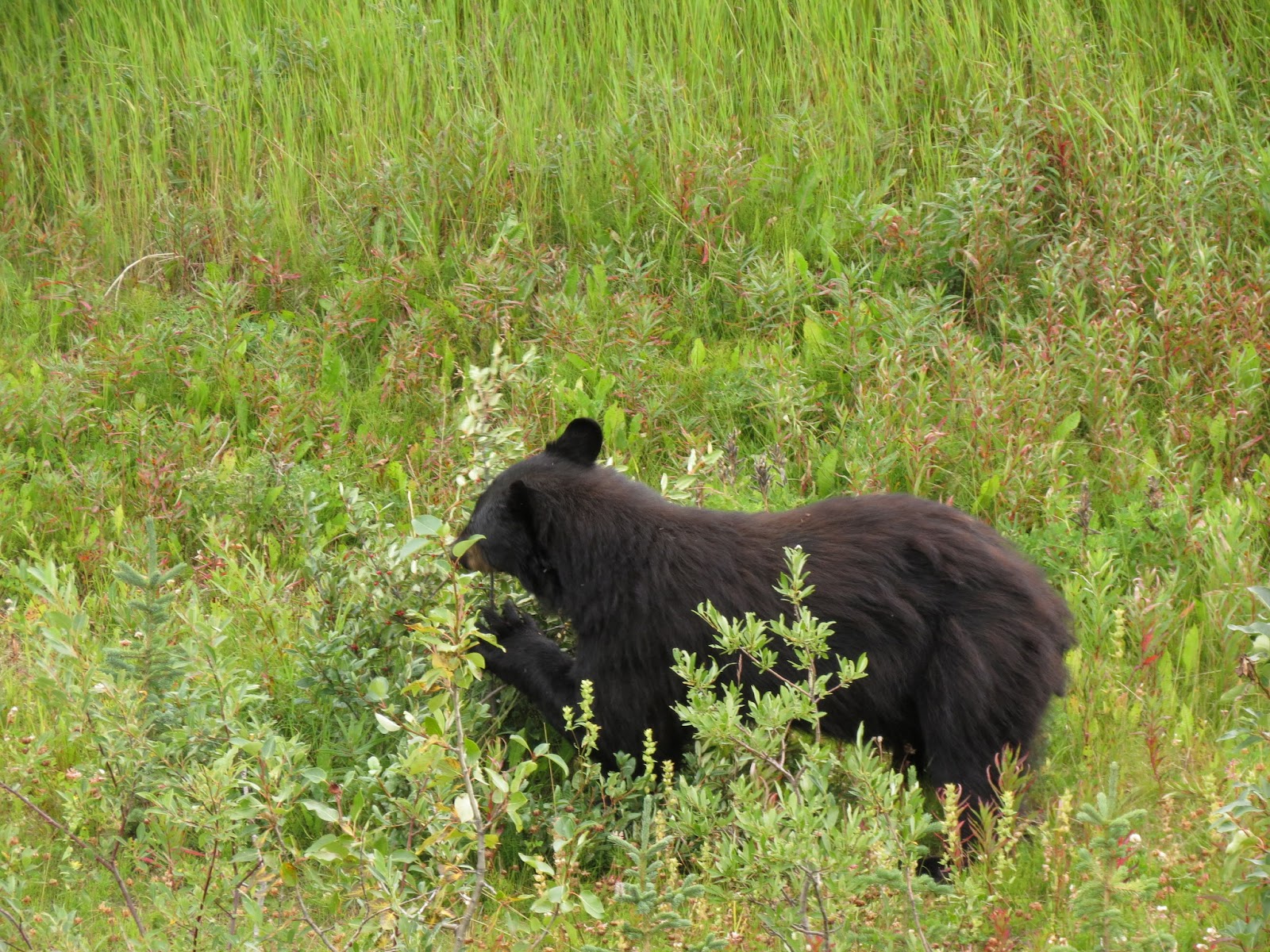
black bear lunching on roadside fodder

our camp at Chilkoot St. Park outside of Haines


Monday, August 10 - Haines area (day 65)
Chilkoot Lake SRA CG

Rained overnight and into the morning. Moving to the RV park for a couple days for the usual reasons, and to be parked close to the city docks for our boat cruise to Juneau on Tuesday.

Was noon by the time we broke camp. On the 9 mile drive back to Haines, Dar kept a lookout for brown bear feeding on salmon in the river. And she spotted one, actually three... a large sow with two cubs. Just had to stop for that show. Got some good picks too.


According to a local, this is a familiar bear to the residents of Haines. Her nickname is Speedy. She recently was tranquilized so a large fish hook could be removed from her nose. Guess the two little ones also got a trip to la la land while their mom was worked on. She probably got the hook in the process of fishing herself, but it made me smile to fantasize that some unlucky fisherman hooked her while fishing... and got much more than he bargained for.

We stopped at the Rusty Compass for lunch... a small local cafe. Had a splendid time talking with the two brothers who own the joint, as well as other customers who wandered in. As far as I'm concerned they've also got the best WIFI in town.

Then it was out to the fairgrounds where we visited Dalton City, the movie set where the movie White Fang was shot. It also just so happened that the current home of Haines Brewing Company is located in one of the movie set buildings. We joined a steady stream of fellow beer connoisseurs eager to sample their concoctions. It's a lean efficient operation evidenced by the fact the owner and head brew master, Paul, was the one who waited on us. He was enjoyable and a wealth of knowledge on beer history.

We also ran into a couple that's going to be on the cruise to Juneau with us tomorrow.


Tuesday, August 11 - Haines area (day 66)
Oceanside RV Park

On the road to Juneau.

Wait! There are no roads that go to Juneau from anywhere else. The only way in or out is by plane or boat. Literally everything there, everything, had to be brought in from outside.

Set an alarm last night to insure we'd be up for the boat, but didn't need it. Out the door and into a seemingly persistent, perhaps permanent, light rain for the short walk to the dock. Walked right onto the boat and took seats near the front on the starboard side.

The Fjordland is a one-of-a-kind boat. She has no sisters. Glen, the owner commissioned it's design and construction about 15 years ago. With a true catamaran hull, it sits low in the water drawing 5 feet, and cuts through the chop and roughness of the inner-passage waters like a hot knife through butter. A much smoother ride than we were expecting. She can do close to 30 knots and today we were running at 26 knots. Has two 600hp Lugger diesels. Passenger capacity of about 50. We covered the 70 miles to the Juneau area in two and a half hours.

The geographic area of Juneau is immense... the second largest city in square miles in the entire USA. Of course, most of that area is wild and undeveloped... annexed by the city for some control over mineral rights. The population is only 32,000. The people of Juneau are used to rain... don't even notice it... as on average it precipitates 320 days per year. It gets, on average, 8 feet of rain plus 8 feet of snow.

A bus met us at the dock about 30 miles north of the city center (but still within the borders of Juneau), and we enjoyed the ride with a knowledgeable and humorous bus driver of English descent from Utah. We had about 3 hours to explore once off the bus.

First up was lunch. With 4 (that's right, four!!!) huge cruise ships in town, the place was crawling with tourists. We found a mildly busy fish joint called the Twisted Fish and had a lunch of local halibut fish and chips, washed down with some tasty craft beer.

The Alaska State Capitol
Then, on to the Capitol building... one of our main reasons for making the trip down here. Nothing is very far away in Juneau and it's a walkable distance even in the rain. Unfortunately, most of the building was off limits due to a large reconstruction project that won't be completed until 2017. We did meet our own requirements for having visited another state capitol, got a few pics, and left. It's not a very impressive building... a 4 or 5 story block office building with a little ornateness here and there on the exterior. The bus driver joked that this Capitol consistently ranks 50th among capitol buildings of the USA. We beg to differ. Florida's is still the ugliest Capitol that we've ever seen.

To kill a little time we stopped at the Alaskan Hotel pub.

Mendenhall Glacier (left) and Nugget Falls (right)
Soon we were back on the bus for a drive out to Mendenhall Glacier. On the way into the park we got a little show from a mama black bear and her cub. They crossed the road right in front of us.

During the hour we spent at the Glacier, we hiked out to Nugget Falls... about a mile each way. Recent heavier than normal rains had the falls roaring. In an effort to get closer we took a path through a creek, complete with randomly placed rocks on which to hop across without soaking your boots. Always one striving to provide entertainment and make people laugh, I was successful at this at least, if not staying dry, by loosing my balance on a tippy rock and doing a backwards ass-dunk in the creek. No injury except to my pride.

A humpback giving us a show

On the boat trip back we had a little more time to look for whales. And find them we did. We'd seen humpbacks in Prince William Sound while aboard the Lu-lu Belle, but we happened upon a group today that gave us a real show. They'd lay on their sides and slap the water with their huge pectoral fins. They'd breach, sometimes almost completely out of the water, not once but dozens of times. Big ones, small ones... they looked like they were having a party. What a treat.


We met a young woman today named Sionaid. But in her 20s, she's taking a few years to travel and see the world. If we ever seriously think we're living an adventurous life on the road... with our motorhome and truck camper, thoughts of Sionaid will snap us back to reality. She's been living now for a year out of her backpack and taking advantage of public transportation and serendipity to move from place to place. It's really all about attitude, isn't it? OK, maybe youth plays a role too. But when you're coming from a paradigm of a mini-mansion house hooked completely to the grid, automatically climate controlled, entertainment systems, multiple refrigerators, walk in closets, and so much space for all your stuff... all the comforts so many of us have come to expect, it's hard to understand the freedom and enjoyment of traveling light.


Wednesday, August 12 - Haines (day 67)
Oceanside RVP

Surprised somewhat that it hadn't rained overnight. But the dry spell didn't last. Most of the day it dribbled.

Kind of a chore day today. Not planning anything much. The RV park is hosting a crab potluck tonight. We did walk up to town for a few vitals, a "dish to pass" for tonight's potluck, and a dose if internet at the Rusty Compass.

The crab boil turned out very nice. Met more travelers with whom to share stories. This is the end of crab season up here, so this'll be the last crab feast of the year.


Thursday, August 13 - Haines to Dezadeash Lake (day 68)
Oceanside RVP

A more rushed morning than usual for us. We're leaving today and taking Sionaid to ferry terminal on the way out of town. My new little Nikon camera turned up missing this morning. Assume it was picked up by someone after the potluck dinner last night... hopefully a case of mistaken identity and not outright theft. Regardless, we're moving on without it. (Correction: Saturday night Dar unrolled her camp chair/sleeping pad and out rolled the camera. Lost is found. Sorry for the negative thoughts and assumptions about fellow travelers)

The day broke bright and clear. The sun felt so good. Best weather day during our stay. The surrounding mountains were stunning. Visibility must have been a thousand miles. Can't express how clear and distinct it was. Southeast Alaska gets very few days like this during the typical year. We're happy we could share one of them.

Drove north out of Haines, crossed the border into BC, and short while later, into the Yukon.

Stopped and lingered at a wayside not far from Haines Summit. Had lunch and soaked in the views. As we drove along Dezadeash Lake decided to go in and check out the campground. Even though it was early, decided to drop anchor and enjoy the bright warm day.


Camp on Dezadeash Lake

Friday, August 14 - Dezadeash Lake to Whitehorse YT (day 69)
Dezadeash CG

Of all the travelers who stay one night in a campground during their trip to somewhere else, we're usually the last to leave. What's the rush? About 30 miles north to Haines Junction where we pick up the Alcan again.

This, the road from Haines Jct. to Whitehorse, is the last section of the Alaska Highway that we've yet to drive. An easy road with a generally good surface and minimal grades and curves that traverses a wooded landscape backed by distant mountains. The highway route is cleared of trees and brush for a wide margin on both sides. For much of the way an earlier alignment of Alcan is clearly visible to the south.

We stopped at the junction with the Klondike Hwy to toast our completion of the Alcan... the Alaska Highway. From Dawson Creek to this point we did northbound. From Delta Junction to here we did southbound. The section from here to the Casiar we will have done both ways. It was a major bucket list item... and now it's finished. Mixed feelings about that. Glad we did it, but hate seeing the bucket list getting shorter. We must find some new things to add.

Since we stayed there on the way north, we knew the closest government campground to Whitehorse so we headed directly there. The other options are RV parks or Walmart. Wolf Creek CG is used a lot by locals and with this being a friday, we knew sites might be hard to come by. We arrived about 2pm and snagged the last open site. And not a bad site at all... sorta away from the large family groups and partiers. Lit a fire, savored happy hour, cooked dinner on the coals.


Saturday, August 15 - Whitehorse YT local (day 70)
Wolf Creek CG

Decided to extend our stay here for another three nights. Would like to see more of Whitehorse. That'll have us leaving on Tuesday. After scrounging together the correct change for the campground self-pay envelope, we drove into town. Stopped first at Yukon Brewing. Liquor laws in the Yukon are not conducive to a proper and satisfying craft brewery visit, but we made do with the tiny samples they had available and bought a few cans for the supply room. We're huge fans of craft beer in cans. It fits our system much better than bottles. More volume can be kept refrigerated in a smaller space, empty cans are much easier to deal with while traveling or out on a trail, and, really, cans are a superior package for beer.

The grocery store was next. This is our best bet for a full-size grocery for the next week or more, so we loaded up. Prices up here are high. How high? A guess, based on a few items I know we regularly buy in the US, is maybe 30 to 50 percent higher. The current exchange rate moderates that a bit, but it's still a penalty that must be paid to live in the far north.

Decided to do a hobo dinner on the campfire tonight. One hour of effort to keep the heat about right with fast-burning wood that didn't want to cooperate resulted in near perfection. Dar made the right amount and we ate the entire thing up with nary a scrap left over.

May 8 - Wyoming State Capitol

This morning we made the jaunt a few miles north to downtown Cheyenne and the State Capitol of Wyoming. Cheyenne is not a big town, although relative to most other clusterings of people in Wyoming, it can feel that way. With a population of only 60,000 hearty folks, getting around town is easy and quick. Our camp on the south end of town is less than 3 miles from the heart of town and the Capitol Building. We probably could have walked if we were ambitious.

Parking was easy-to-find right on one of the streets that run alongside the Capitol grounds. Upon entering through the main front doors at the top of the portico steps we were confronted by the lack of a security checkpoint, no x-ray machines, nor any walk-through metal detectors. No sir, the State Police have a desk in the rotunda on the first floor and that’s about it. Clearly the good citizens of Wyoming don’t feel the need to over-do the security thing... and retain the sense of liberty one gets by just going in whenever one feels like it... no questions... no hassles.


We had wondered why Cheyenne is the Capital City of Wyoming... what with it being in the extreme southeast corner of the State. Many other States we’ve visited have taken pains to locate their Capital in a central spot, as close to the middle of the State as possible. So how did Cheyenne become the Capital?

Cheyenne was born in 1867 in the path of the rapidly expanding transcontinental railroad. Union Pacific crews arrived as they laid the tracks westward. Cheyenne soon laid claim to a higher status than older settlements like Fort Laramie, Fort Bridger, and the mining town of South Pass City -- changing Cheyenne from a village to a city in a matter of months. The seat of the new Territorial Government was established in Cheyenne in 1869. Apparently, no one’s felt a need to challenge that decision since.

One can also speculate that there was very little population throughout the rest of the Wyoming Territory and that Cheyenne’s proximity to Denver and it’s relative closeness by train to Omaha and other population centers to the east also played a role.

The building was built between 1886 and 1890, prior to statehood for Wyoming (1890), and expanded again in 1916 when the two large wings for the legislative chambers were added. Between 1974 and 1980 the building was extensively renovated.

What we saw today impressed us as stately and fitting for this big but wild western state. Surprisingly, it’s the original Capitol... so they got it right the first time. Many other states have moved their State Houses multiple times, or they were built too small or in the wrong place, or they burned down. But Wyoming got it right and it’s still in daily use by the Governor, Secretary of State, Treasurer, and Auditor, in addition to the legislative chambers. That fact alone puts it in rare company among other states.

The building is in the traditional style... modeled after the US Capitol in Washington DC. A central rotunda sits beneath a large dome and two adjoining wings contain the House and Senate Chambers. The impressive dome is 146 feet hight and is covered in sheets of copper. But in 1900 it was decided to gild the copper with 24k gold to help maintain a bright, fresh, un-tarnished look. It’s been gilded 4 more times since then, the last in 2010. The exterior is various shades of sandstone, much of which came from quarries in Wyoming. The interior floors are a “checkerboard” of both white marble from Italy and black marble from Wyoming. Many of the black tiles contain imperfections which are actually fossils. The impressive staircases, doorways, and doors are cherry.

Popping into the House Chamber for a look, we were impressed with the good-looking desks used by the representatives... oak with marble tops. Surprisingly, these are relatively new having been commissioned and installed in 2001. Before that time the lawmakers used army-issued metal desks. They served their purpose for near a hundred years.

Overall, we liked the place. This being our 30th state capitol, we’ve found a few along the way we really didn’t like (good old Florida tops the list), but most are reasonably impressive and seem to serve both the symbolic and functional reasons they were built. Wyoming fits right in there. Those Territorial leaders who commissioned this building had foresight... they did a good job. The building still works today and appears to be poised to go on doing it’s job for the foreseeable future.

After our visit we sought out and found a brewpub... a near-tradition for us on Capitol visitation days.  We had an enjoyable time at Shadows Brewery and Grill in the old Union Station building... despite their lack of the most important craft beer a brewpub can make... IPA. Life isn't easy all the time.

More photos in our online photo album...[click here]

Took me a while to figure out that "Crook" is the County he represents...
 and not his profession.

Dec 28 - The Mississippi State Capitol

I was grumbling to Dar about all the rain we've been getting the past few weeks and thought some facts might make her more receptive to my childish whining about stuff I have absolutely no control over. So I checked with the US Government... NOAA to be precise... and found that most of Mississippi, Alabama, and northern Georgia have received between 4 and 6 inches of rain in just the last two weeks. And we were there. Great information... but it didn't help at all as she still thinks I'm making a big deal over nothing.

It rained most of the night. I woke to rain. And it rained most of the day today. It's probably still raining as I punch out this post from under the covers of my bed... a place I find more uplifting than looking out windows at puddles, mud, and dreariness. I'm trying to be mature about this, but there's only so much a guy can take.

We drove over to Jackson Mississippi this morning and found the State Capitol in the middle of a downtown that felt abandoned. I suppose the days between Christmas and New Years are a grand time to take that unused vacation time or to just play hooky. There were so few people that parking was readily available, many restaurants were closed for the whole week, and traffic was so light they could have turned off the traffic signals to save a few bucks.

There's actually two Capitols here... the old historic one that's now a museum, and the "new" Capitol that was built in 1903. It's this newer building that was the target of today's exploration.

Did I mention it was raining? We parked as close to the Capitol as we could, grabbed an umbrella each, and scampered to the front door. Inside the door there's a security screening station where it took a couple passes to successfully get through the metal detector. The guard found my little pocket knife which he said he'd have to confiscate as they're not allowed inside... but, on second thought... he told me to go ahead and keep it as there were few people in the building and certainly no one they needed to protect from a mild-mannered mad-man from Wisconsin.

The building is designed in the traditional style (central dome, columns, rotunda, space for legislature, executive, and judiciary). As government grew, the Supreme Court and the Governor moved out to more spacious accommodations across the street. Both houses of the legislature still meet here but there's not enough office space to give every legislator a private office. Some use their desk on the floor of the House or Senate chamber as their office.

While looking down on the House chamber from the gallery above, I noticed a dozen or more curiously shaped sticks (walking sticks? canes? or what?) on various representative's desks. I asked our tour guide what they were?  She didn't know but said she'd find out. An official from the House was handy so we asked him. He smiled, chuckled, and said some people might not like the answer.

You see, often legislators lean back, recline, in their big oversized and overstuffed desk chairs, and get very comfortable during long sessions as they listen to arguments, debates, and speeches. When it comes time to vote on a bill (the House uses an electronic voting system), they grab their stick, and from their comfy reclined position reach over to the little keypad on their desk and tap the Yea or Nay button... all without having to waste any more energy than necessary by sitting upright to vote with a finger. Down here in Mississippi, this is what they refer to as an energy saving vote.

Something else unique in this Capitol is that the House and Senate chambers are turned 180 degrees from the traditional. In every other Capitol we've visited walking onto the chamber floor from the rotunda side, you'd be entering the chamber at the back. The focus of activity, the front of the chamber, is on the furthest side from the rotunda. Here, that's reversed. You enter the chamber at the front and the focus of activity is on the side closest to the rotunda. Each chamber also has it's own massive dome which adds even more magnificence to an already impressive space.


The interior of the building is very light, illuminated by more than 7,000 incandescent bulbs that form constellations of light that's both impressive and attractive. The building lacks much in the form of symbolic art but decorative art is all around in the form of leaded glass windows, brightly painted walls, and repeating design motifs. It's the only State Capitol I can recall that has stained glass windows depicting historic elements of the State... in this case the Native American, Mother Mississippi, and the Pioneer Settler.


Also unique among the Capitols we've visited is the method of funding for the building. In this case, the 1903 price of just over $1,000,000 was paid for by the Illinois Central Railroad... as settlement for back taxes owed to the State.

We both really enjoyed our visit to the Mississippi State Capitol. Our guide, who was knowledgeable, fun, and energetic, really added to the experience and provided some background that we wouldn't have picked up on our own.

After our visit we repaired to an establishment a couple blocks away called Ol' Tavern for a couple craft brews and an excellent lunner. The old building was exposed brick and wood, high ceiling'd, basic, and had the feel that many generations of State workers and legislators relied on it for sustenance over the years.

It was about as good a day as one could hope for. And even the rain stopped before we were through.


Dec 13 - The Alabama State Capitol

Today we explored the historic Alabama State Capitol. Built prior to the Civil War, what it lacks in size and stature it more than makes up for in historical significance. In 1861, it temporarily served as the first Capitol of the Confederacy... where the first Confederate Congress met, formed a government, and wrote a constitution... where Jefferson Davis took the oath of office as the first President of the Confederacy. Later in 1861 they moved the Capital to Richmond Virginia.

Not large by any means, the building was built in the traditional style with a central dome and rotunda flanked by two wings that originally contained the legislature... the House on one side, Senate on the other. It's among the oldest Capitols in the United States (the 11th oldest), having been built in 1850.

While the building is still the official Capitol and does house the Governor's and a few other departmental offices, it's now mostly a museum. In 1940, the Supreme Court vacated the old building and moved to it's own digs in the same neighborhood. And during an extensive Capitol renovation project in the 1980s, both houses of the Legislature moved to a large building across the street now known as the Alabama State House. That move was supposed to be temporary but as the sands of time slip through the government hourglass it's beginning to look more and more like it was permanent. I think they got used to their plushy surroundings, private offices, and modern conveniences. In deference to the law and to the old Capitol building, they do open the legislative session each year in the old chambers.

Historic Senate Chamber. The Confederate Government was formed here.

We were able to wander through much of the old Capitol during our visit, except for the Governor's Office which was strictly off-limits.

The central core of the building is three stories above a below-grade basement, as is the East Wing addition added in the 1880s. The North Wing and South Wing additions, added in the early 1900s are each two stories above a raised basement. From the outside it presents itself well as the State Capitol. Inside, although bordering on spartan, it's been nicely restored to the elegance of an earlier time.

House and Senate are buried deep in the upper floors of this office building.

During our usual visit to a State Capitol we get onto the floor of the House and Senate Chambers. Since they hadn't moved back into the renovated Capitol yet, we had to trudge across the street, to the so-called State House, take an elevator to the 5th floor, and beg our way onto the floor of the House Chamber. From there we had to take another elevator to the 7th floor where more pleading got us into the Senate Chambers. Both were business-like spaces that resembled an office building auditorium. I wonder, with all the current glorification of all-things-business and the corresponding shunning of all-things-government, if we were looking at the future. I mean... just think what the real estate those old Capitol buildings are sitting on is worth?  Just imagine what a developer could do with condos and strip malls and trendy restaurants right in the middle of town... why, it boggles the mind!

Across another street from the Old Capitol was the historic First White House of the Confederacy. We stopped by and did a self-guided tour of the nicely restored large old home. It served as the residence of Jefferson Davis for only a few months, but the local First White House Association has made it their life's work to preserve it.  More photos in our online photo album from today.

The Intrepid Explorers on Jeff Davis' front porch.

Dec 7 - Atlanta and the Georgia State Capitol

Decided to wait a while this morning and let the rush-hour traffic in the Atlanta area moderate a bit. My experience is that it never abates completely. For a while (and on the recommendation of some good friends) I considered parking out near the airport and catching MARTA, the public transit train system, in order to avoid parking hassles downtown. But after some research I wasn't confident this option was much better as the stations were some distance from our route. I just decided to tough it out.

The drive in went amazingly well. We'd mapped the route out in detail and encountered no real slow-downs at all. Exiting I-75 when we saw the golden dome of the Capitol, it was only a matter of a few blocks to a parking lot just a block from our target. While the parking was easy... it was expensive.

The Capitol was constructed after the Civil War between 1883 and 1889. The budget was $1 million. If you can believe it... prudent spending brought the completed building in UNDER budget and the Capitol Commission actually returned about $100 to the treasury. Seems they could have had a party or something with that hundred bucks and still be congratulated for coming in right on budget.

It's a big, grand old building. Four floors and just a few feet shorter in height and length than the US Capitol in Washington DC. Much of the interior is done in mostly Georgia building materials, mostly marble and wood, but the exterior is Indiana limestone... an effort to keep building costs under control.

Atop the gold leaf gilded dome is a statue of Miss Freedom. Although she looks petite and trim, she's 26 feet tall and weights 1600 lbs. The torch in her uplifted right hand is lit at night.

We did the guided tour, learned about some of the many portraits of key figures in Georgia history (including Confederate leaders) and most of it's previous governors, and stood in both the Senate and House Chambers. The 4th floor houses the Capitol Museum, a collection of artifacts and exhibits from Georgia history. We also visited the Governor's Office suite. Unfortunately, the new Governor, Nathan Deal, was out that day... someone said perhaps he was out making deals. But we did talk with his secretary who gave us a short private tour of his office as well as a bag of Georgia peanuts. How can you beat that?

This was our 27th State Capitol. I gotta tell you... they're all starting to look alike. Except for Florida... which is in a class by itself.  As always... more photos from our day can be viewed in our online albums.

We did spend more time downtown after our almost three hour Capitol visit. But that will be the subject of another post.


Not sure why there was a newspaper slot on the door to the mensroom...?

Nov 27 - South Carolina State House

A few years ago, during one of our prior visits, Cousin Deb gave us a driving tour of Columbia South Carolina. One of the spots we stopped was the Capitol Building, here referred to as the State House. Unfortunately, it was a Saturday and the building wasn't open. Left to walk the grounds and view the exterior... both of which are impressive, we knew we'd have to return another time to do the interior. So today we took care of that unfinished business.

Most of this building, the exterior walls anyway, pre-date the Civil War. Construction was started in 1855, slowed considerably during the war, and stopped altogether when Sherman marched through Columbia, burning some government buildings and shelling the walls of the unfinished State House. (There are six remaining scars from that action, marked by six bronze stars.) After the war, it took until 1907 to finish the building, although parts of it were put into use during the process.

We found it to be a typical capitol building in the traditional style... central rotunda, dome, legislative branches on either end, etc. Design features make it appear larger on the outside than it is inside. For the most part, it's a two story building -- with the Governor and Lt. Governor's offices in the lowest level and the legislative chambers on the main level. There is a third level that is mostly for the public galleries in the senate and house chambers.

Between 1995 and 1998 the building was renovated and returned to it's original grandeur.

While not the most impressive State Capitol we've visited, it is respectable and holds its own among the 25 others we've visited over the years.

Main rotunda and statue of John C. Calhoun

interior shot

During Civil War, General Sherman's gunners hit the unfinished building a few times.

July 3 - North Dakota State Capitol

There's a lot to be said for North Dakota these days. Contrary to the miserable financial condition of most States in the Union, North Dakota is in great shape money-wise. As a result of all the drilling and production activity in the booming Bakken Oil Field in the western part of the State, they've got money coming out of their ears. There's a huge and growing rainy day fund into which they keep pouring money. And although recently rejected by the voters, the fact that some group could actually propose the abolishment of all property taxes says a lot about how well-heeled North Dakota actually is these days.

If nothing else, North Dakota is an example of fiscal restraint... of only spending the money they have and no more. The legislature meets for only 80 days every other year. During that time they hammer out a few hundred pieces of legislation and balance the budget... and then they go back to their normal lives (which for some, means full-time fund-raising for their next election.) Granted, with the recent inflows of oil money the job of balancing the budget has grown immensely easier. Regardless, the budget is balanced.

But this fiscal restraint is one of the reasons North Dakota is well down the list of State Capitols when it comes to traditional stateliness, soaring classical architecture, and grandeur. Here's a quick version of the story:

In 1930, on the 28th of December, the original State Capitol caught fire... and the building along with almost all of the contents was a total loss. In one night, they were left without a center of State Government.

Consider the time... 1930. The nation was a full year into the Great Depression. There was much uncertainty about the future of American affluence, the American Dream, and the ability of the system to "right itself" after the systemic collapse. There wasn't much money to be had... much less the consideration of what the people would think if the Government can build a gilded temple while common people have trouble feeding their families.

At the same time, the use of steel in the structure of tall buildings was becoming common and "fashionable" by the use of relatively cheap steel skeletons covered with a facade of stone.  The famous Chrysler Building (1930)  and the Empire State Building (1931) were popular in the minds of a public yearning for innovation and grasping for symbols of hope for the future. If your goal was to produce the most office space for the least amount of money, high-rise construction was the way to go.

So by August of 1932 plans had been drawn up and construction started on a 19 story skyscraper with a wing attached for the two legislative chambers. When completed in 1936 it was, and still remains, the tallest building in North Dakota. The budget was locked at $2 million dollars... a modest amount compared to the capitols of surrounding States. In fact, portions of the original Capitol grounds were sold off to help finance the project.

An additional wing for the Judicial Branch was completed in 1981, and other buildings on the 160 acre Government Campus are used by other agencies and departments.

My knee-jerk reaction when researching the building prior to our visit was mostly negative. I've been hard on other high-rise Capitol designs (Nebraska, Louisiana, Florida) in that they're really more a functional office building than a formal symbolic seat of Government, museum, and art gallery honoring the efforts of the people who brought the State into the Union as well as a celebration of the power of the people to govern themselves. Of note, North Dakota's, Nebraska's, and Louisiana's Capitols, all high-rise designs, were all built in the early 1930's.

But this visit made me appreciate the period, the need, and the available resources... and I was more impressed with what they did than I thought I'd be. The building is tastefully decorated, with key symbolic elements in the soaring 40 foot high Memorial Hall, which takes the place of the Rotunda in most traditional domed Capitols. The Ground Level contains portraits of North Dakota's Hall of Fame... about 40 or 50 people from the State who have made a significant contribution.

House Chamber in North Dakota State Capitol
 We did enjoy our visit to the North Dakota State Capitol and, significantly, I believe it gave me a new appreciation for considering the external factors that go into decisions about symbolic buildings like this.

However, I still can't bring myself to forgive Florida for building that "Insurance Company Office Building" they call a Capitol in the 1970s. Some things just can't be forgiven.

June 26 - Montana State Capitol

This is our 24th visit to a State Capitol Building, and I've got to say... it's beginning to feel a lot like the experience you have when looking for a new house with a real estate agent... after five or six... or ten... they all start to look alike. But we can't stop now... we're almost half way through the list of 50.

"Buck up, old boy... you can do it!"

Unlike many States, this is the only building Montana ever designated as the State Capitol. Admitted to the Union in 1889, they did the right thing by initially meeting at the old territorial capitol, at hotels, at bars... wherever there was a space large enough to get a quorum and conduct the business of State. Some might feel that's the way it should have stayed, but about 1896 a group of legislators felt it was time to create a decent Capitol... a Capitol that would stand up well to the Capitols of surrounding States... a building the people of Montana could feel proud of... a central place you could go and find the bastards responsible for the issue you feel strongly about.

So, in 1896 the first Capitol Building Commission was formed and sought plans and bids from architects across the nation. The winning entry was one from St. Louis architect George R. Mann. Unfortunately, that plan, and the first Capitol Building Commission was scrapped and disbanded when it was discovered that it's members were planning to scam money from the project. So a second Capitol Building Commission was hastily formed and the plan selected was from the architects of Charles Bell and John Kent. An interesting side-note... three years later, George F. Mann's original plan was re-worked and selected as the model for the new Arkansas State Capitol.

It was constructed between the years of 1899 and 1902. Wing extensions were added in 1910, but the building has remained basically the same since that time. A unique feature is that the chambers of both legislative bodies, the House and the Senate, are located in the same west wing of the building... haven't seen that before.

Like many other Capitols, this one was subjected to a lot of abuse during the middle part of the 20th century, when the notion of the day was to paint over those decorative details, rip out those sky-lights, jam more cheap office space into nooks and crannies here and there... all in the name of keeping it cheap and efficient. If efficiency is what we're after in a seat of government, we'd all have a State Capitol like Florida's... a high-rise office tower that reminds me of the Communist tenement apartments we found behind the iron curtain in the early 90's. It didn't work for folks living in those drab concrete towers... and it doesn't work for a seat of government. There must be elements that impart the feeling of unity... of history... of the struggle and efforts that went into achieving statehood.

Thankfully, also like many other States during the 80s and 90s, the State of Montana decided to refurbish their aging but stately relic... and to bring it back to the condition it was just after completion. There are art works that reflect the early people who had an impact on the State... the Native American... the Mountain Man... the Miner... and the Cowboy. There are sculptures of native Montanans who made significant contributions to the State.

Charles M. Russell: "Lewis and Clark meeting the Flathead Indians at Ross' Hole"

The most significant piece of artwork we saw was the Charles M. Russell masterpiece entitled "Louis and Clark meeting the Flathead Indians at Ross' Hole". It's a massive work, stretching 25 feet by 12 feet and covers the west wall of the House of Representatives. The story goes that Charlie had to expand his cabin/studio in order to fit it in during the creation process. Standing up to the test of time, it's considered the apex of Russel's work... and it's right there in the House Chamber for all to see... and not in some one-percenter's private collection or in some obscure museum.  HoooRaaaa Montana!

After our tour, and while we were wandering, lingering, around the magnificent structure, a glance out a north-facing window revealed that the big wildfire from the day before had re-stoked... and appeared to be heading right for our camp. We decided to head back to the bus-house and forgo lunch downtown.


May 5 - Idaho State Capitol

  • Moved from Mountain Home ID to Boise ID
  • Explored the Idaho State Capitol (yes, a move and an exploration all in one day)
  • Bus-house Miles Today:  44
  • Total Spring12 bus-house miles:  2,103
  • Toad Miles Today: 22
  • Total Toad Miles Spring12:  1,002
  • Tonight's camp:  Mountain View RV Park  elevation: 2,880
  • Weather: morning low 34f,  afternoon high 55f; windy and  mostly cloudy, but clearing later in the day.
  • Notables: 1. Exploring an impressive classically styled Statehouse  2. Doing a move and an exploration... both in one day.  3. Improving weather means more sun and warmth in the next few days.
  • Link to photo album for today
=====

After yesterday's wind storm that resulted in us hunkering down at Mountain Home RV Park in the town of the same name, and after a good nights sleep, we were up and on the road at the startlingly early time of 10:30am this morning.  Dar came up with the great idea that if we could find a convenient RV park near the highway in Boise (which is only 45 miles away), we could do double duty today... that is, move and visit the Capitol of Idaho in the same day. So that's what we did.

With Boise less than an hour from Mountain Home, it didn't take long and we were there. We found a suitable parking site at Mountain View RV Park, near the Boise airport and just off I-84. After unhooking the toad and grabbing a quick lunch, we headed downtown.

Entering the downtown area it becomes evident that the Capitol... as large and stately as it is... is not the tallest building in Boise. No, since the 1970's, there are two Bank buildings (and soon to be a third) that dominate the "skyline" and diminish the Capitol both literally and figuratively. A sign of the times I guess... when the banking business is the dominant force in our lives.

Designed by architects John Tourtellotte and Charles Hummel, and built between 1905 and 1912 (the central part of the building, the rotunda, the dome, etc.), it's an impressive structure with 5 working floors and a massive dome that tops out at 208 feet. Built in stages, the wings for the Legislature (House and Senate) were added in 1920. That's the full structure one sees today. What's not seen are two large one-story underground additions built a few years ago that extend beyond the visible building and provide additional space for Legislative offices.

There are two things in particular that made this building stand apart from others we've seen and from what we expected: First, the building's interior is awash in natural light. The original architects designed-in large skylights, windows, and open spaces to brighten the interior. A large renovation project in the early 2000s removed false ceilings, walls, and other features that had been added over the years, and returned the old building to that envisioned by the original planners and architects. It's probably the brightest interior of all the 23 Capitols we've visited to this point.

The other thing that stands out is the lack of art and symbolism. The rotunda is a 4 story high marble lined, bright, impressive place. But what's not there is art... paintings and sculpture telling the story of the struggle and heritage of the people who made the State what it is. The reason for this omission isn't clear to me, but apparently the original planners made a conscious decision to let the building stand on it's own... to let it be it's own work of art... to tell it's own story.  Don't get me wrong, it's an wonderful building... one that the people of Idaho have a right to be proud of.  But in my humble opinion, having it help tell the story of the people could only add to the overall impact of the place.

-----

With our job in Boise completed, we're planning to head out again tomorrow. The objective is the LaGrande area in Eastern Oregon, where we might spend the next few days.


click to zoom in.
Can you name this orater?

The Utah State Capitol

It's easy to find Utah's State Capitol. Perched high on a foothill on the north side of downtown, it's visible from all over Salt Lake City and the surrounding valley. Our approach was from the West, on a narrow neighborhood street that was so steep our Ford Focus Toad was straining in first gear to make the hill. Coming from the South, from downtown, the approach is less steep but still significant. Once atop the hill we found a stately building that fits right in with the Capitols of many other states. Columns, broad stairs leading to the "front doors" on the second floor, a large dome... it looks like a Capitol. This will be the 22nd of these grand buildings we've explored.

Some other states have filled their Capitol grounds with trees... in some cases, so many and so mature, it's hard to see the building (Nevada comes to mind.). But not Utah. The building stands alone, without trees, on the acreage that contains it. The open feel of the setting is appropriate for the hilltop location and is symbolic of the wide open expanses of this western State. The formal approach to the building is made from the south on a long broad walkway and sets of stairs that can get a visitor's heart a-pounding well before reaching the doors. Slow down.  Remember, we are almost a mile high and there's less air up here.

But once there, stop. Don't be too quick to enter. Take a moment, turn around, and take in the view... of the Salt Lake Valley to the south and west... of the mountains to the east... and of Salt Lake City below. At least in my book, Utah gets first prize among all the States' Capitols we've visited in the category of "best view from the front door".

click to see full size panorama of view from the front door.

This building was commissioned in 1912 (several years after Utah was admitted to the Union in 1896) when someone noticed Utah didn't have real Capitol like the other States. The idea caught hold and before long local architect Richard K. A. Kletting was commissioned to create the vision. Construction took more than three years and it was completed in 1916.  The exterior is local granite... gray, strong, and impressive. The interior, especially the second (main) and third floors, is mostly marble. Tall columns with Corinthian Capitals adorn both in and out. The style is supposed to be Neoclassical revival... whatever that is.

The Utah State Capitol is the active house of State government. It houses the chambers of the Utah State Legislature, the offices of the Governor and Lieutenant Governor, as well as other supporting offices. In contrast with many Statehouses which have the House and Senate chambers on opposite ends of the building, Utah's design has the House on one end, the Supreme Court on the other, and the Senate in the middle. Most of the Supreme Courts day to day business has moved to another building, but the historic courtroom is still used for mostly ceremonial events.


Large paintings around the rim of the dome, the corners of the rotunda, and the ends of the vaulted atrium represent various scenes of Utah's pioneer heritage. Other sculptures and works of art are common around the building, and galleries on the 4th floor feature rotating exhibitions about Utah's history and heritage.

Between 2004 and 2008, an extensive renovation and reconstruction effort spruced up the building, returning it to it's original grandeur. Part of this effort was extensive work to make the building capable of surviving earthquakes. Essentially, the whole place is now sitting on 250 new "base isolators" which allow the ground to shake independently of the building.

It's a "must see" in our book... and ranks right up there among the better State Capitols we've visited. And there are many more photos in our online photo album.

-----
Here's a link to the photo album from this visit.
Thom and Dar visited the Utah State Capitol on April 30, 2012

Apt 12 - Santa Fe and the State Capitol

  • Explored historic Santa Fe and the New Mexico State Capitol
  • Toad Miles Today: 3 (to/from train station)
  • Total Toad Miles Spring12:  356
  • Tonight's camp: Santa Fe Skies RV Park
  • Weather: morning low 43, afternoon high 63, partly cloudy, no rain
  • Notables: 1. a private tour of Governor Susana Martinez's cabinet meeting room and office by the Governor's receptionist; 2. the phenomenal amount of art work in the Capitol... in some ways it's a big public art gallery; 3. absorbing the fact that earliest impact of European influence was here... prior even to the Pilgrims landing on the east coast.
  • Link to our photo album for today.
=====

We had no idea when we selected Santa Fe Skies RV Park as our camp for the two nights we planned to be in the Santa Fe area that we'd be just a mile away from a mass transit train station. The system is called "Rail Runner" (a play on words that's similar to "road runner", the state bird) that would, for only three bucks, whisk us downtown in about 20 minutes of hassle-free comfort and deposit us just four blocks from the target of our exploration... the New Mexico State Capitol. I mean... how could we go wrong?

So this morning we drove over to the station and boarded the 10:51am train. When we lived in the Chicago suburbs during a previous chapter we almost always used the train to get downtown Chicago... and I had trouble understanding why more people didn't. It's cheaper than paying to park downtown, it's much less hassle, you can sip coffee while reading the newspaper, and you don't have to deal with road-rage almost every day. Santa Fe's system is much smaller, really built to connect Santa Fe with Albuquerque a bit less than an hour down the road. Many folks who work in expensive Santa Fe live in much less expensive Albuquerque, and the RailRunner system eases congestion on the linking segment of I-25, traffic on city streets, and the need for fewer parking lots, etc.

The New Mexico State Capitol

Once off the train, we high-tailed it over to the Capitol Annex and the Capitol itself. Santa Fe has a unique architectural feel to it... screaming "Southwest". It's a mixture of Spanish, Mexican, and Native American, combined with local building materials. Buildings, even downtown, are rarely more than 3 or 4 stories high... most just one or two. Roofs are flat. Exterior materials are adobe and stucco (and their modern equivalents). Somehow, it's all scaled down and doesn't feel like a town of almost 100,000 people.

During the very early years of Santa Fe, from 1610 to 1886, various governments were housed in a large one-story building called the "Palace of Governors". It still exists right on the old central plaza and now houses a museum, shops and art galleries.

Street vendors line the Plaza side of the "Palace of Governors" the 400 year old government building on the Plaza.

A new, second Capitol was built in 1886, a domed affair more similar to the classical styles other Territories and States were constructing about the same time. It burned down after just 6 years in 1892.

A third Capitol was constructed in 1900 and served first as the Territorial Capitol and from 1912, as the Capitol of the new 47th State. This building was extensively remodeled in 1950 to completely change it's character to one more in line with the Southwest style and the rest of Santa Fe. It's dome was completely removed and various other parts razed, others added, until only the most astute observer could recognize anything from the original building. That building still exist today as the "Bataan Memorial" building and houses many functions of current State Government.

The current Capitol was built and occupied in 1966. It's a round 4 story building that when viewed from above resembles the Zia Sun Symbol -- a symbol closely associated with the Native Peoples of New Mexico. Unlike any other Capitol we've visited, I believe it could only work here in New Mexico. Like so much of Santa Fe, it just feels right.

Inside, there is a central Rotunda that highlights the Great Seal of the State of New Mexico. The skylight above represents an Indian basket weave. The Rotunda is lined with native Travertine Marble, and the flags of all 33 counties are on display.

The House and Senate Chambers are on opposing sides of the building, and the offices of the legislators are scattered around the second and third floors. The fourth floor is primarily the executive branch, most notably the office of the Governor. The current Governor is Susana Martinez, New Mexico's first female chief executive. We stopped in front of her office suite and snapped a few pictures while exchanging greetings with the receptionist. I guess she thought we were harmless enough and invited us in for a mini-private tour. I'm sure if the Gov had been in, that wouldn't have happened. But she joked that she needs a break once in a while and loves to show off the Cabinet Room and the Governor's private office. Her enthusiasm and passion was evident as she explained the various works of art and the features of both rooms. It was the highlight of our visit and something we'll always remember.

Entrance to the Governor's Office

When it comes to art, this Capitol tops the list of the 21 we've now visited. The walls of every hall and public room is lined with over $7 million dollars of art from the Capitol Art Collection. It all has a New Mexico theme or tie-in of some sort... and it's a real treat. And it turns an otherwise nice office building into it's own masterpiece.

On the advice of a Capitol security guard, we had an outdoor lunch at a little cafe just up the Old Santa Fe Trail from the Capitol. Then we strolled toward the historic Plaza, but stopped along the way to see (and snap photos of) the San Miguel Mission (the oldest church structure in the USA), the Oldest House in the USA, the Loretto Chapel (home of the mysterious self-supporting spiral staircase), and the mighty Santa Fe River.

We then wandered around the Plaza and absorbed the scene... the street vendors, the old buildings, and the activity. We were standing in the middle of the oldest Capital city in the United States, and one of the oldest European settlements in the Americas. This part of the USA is also the location of another advanced native civilization dating back many hundreds of years prior to that... but more on that in a later post.

We had visited New Mexico about 15 years ago, on a week long vacation with our Son. During the few days we stayed in Santa Fe, we stayed at a small resort/spa just a few blocks from the central Plaza. Neither Dar nor I could remember the name of the place so, just for fun, today we tried to find it. And we did. It's called La Posada, a collection of dispersed small buildings, casitas, of various sizes and shapes built mostly before 1900. It's all tightly woven into a private and secluded setting among tall trees. It felt good then and it still feels good today. I remember that many folks involved with the Manhattan Project during WWII stayed here on their way to or from Los Alamos, about a two hour drive (in those days) up into the mountains. That added to the sense of history of the place.

The Senate Chambers

San Miguel Mission... the oldest church structure in the USA

The Capitol Rotunda